

| Title | Summary | |
|---|---|---|
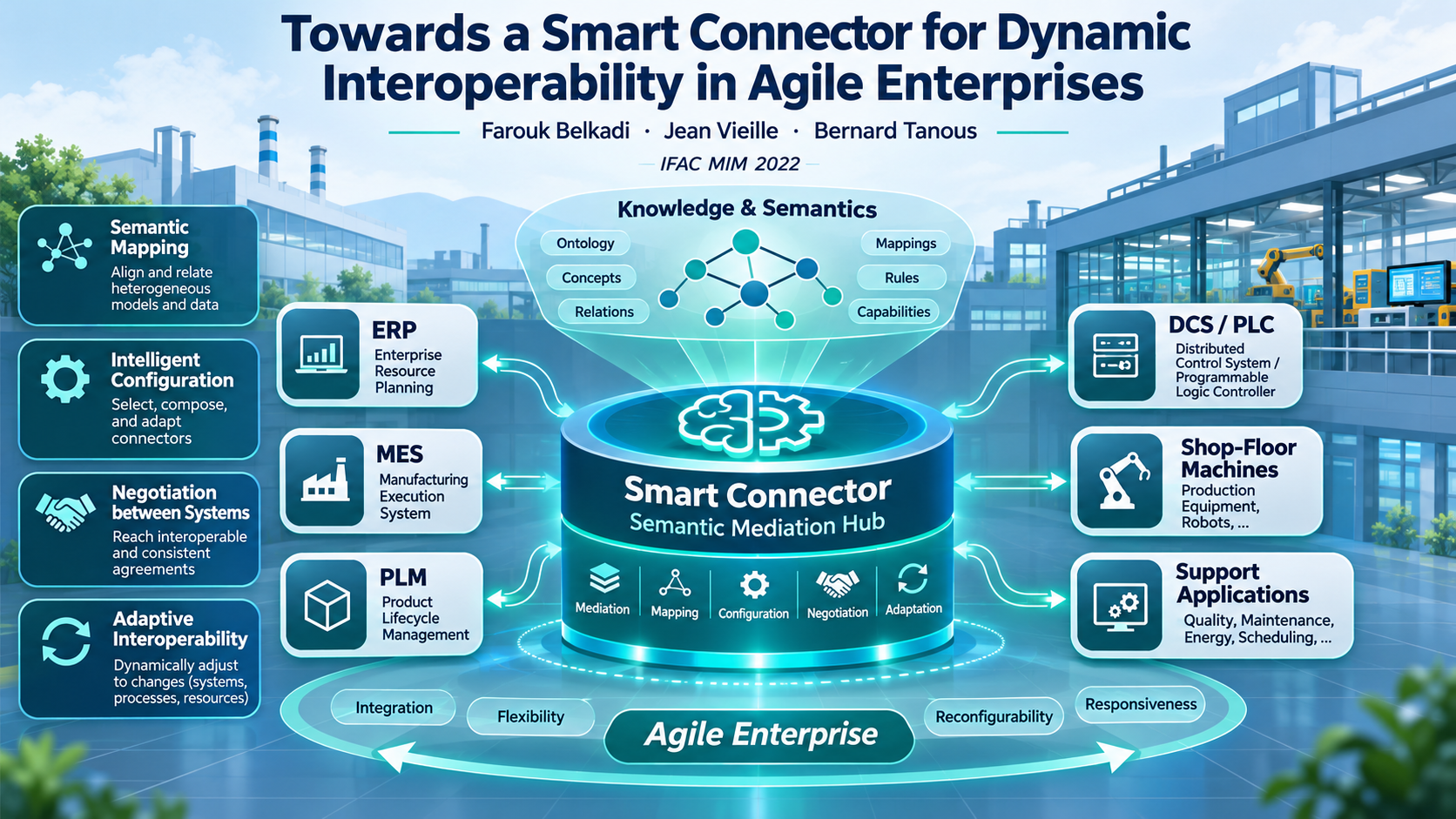 |
2022 Towards a smart connector for dynamic interoperability in agile enterprises |
Abstract: The “industry 4.0” transition requires a digital chain capable of self-adapting face to evolving and increasingly complex organizational, informational and technological contexts. For this need, this paper discusses the incentive to develop new kind of connectors, intelligent and pragmatic, as a unique and universal interface to support interoperability between different types of technological and software systems in various collaborative processes in the enterprise of the future. download view |
 |
2026 Toward a Systems Perspective on Information |
Systems may make effective use of observations, diagnoses, representations, procedures and expertise; in other situations, these resources may be only partly exploited or remain unused when a response is needed. Another system may receive data correctly while misunderstanding what they refer to. This essay relates informational resources, capabilities, and processes within interacting systems. It examines how signs and representations make selected aspects of reality accessible, how knowledge and capabilities are mobilized under contextual and temporal constraints, and how present activities can change future possibilities. An illustrative industrial-valve case connects a missed deterioration trend with a semantic error at an interface. The article distinguishes retained results from learning and effects on the acting system from effects on other systems. Four complementary figures and five questions for prospective design make the proposed synthesis tangible. Its immediate aim is to identify informational possibilities that could be better used; its wider research context concerns representation, knowledge, intelligence, organization and control.
download view |
 |
2026 ISA-95 Today: Enduring Concepts, Models Worth Revisiting |
This article revisits ISA-95 in light of contemporary industrial architectures and representation needs. It distinguishes between the enduring industrial concepts introduced by the standard, the specific models used to organize them, and the growing challenge of maintaining coherence across distributed representations. Using the example of a functional equipment position, P101, and the physical assets that successively fulfil that role, the article examines the distinction between functional levels, applications and IT architecture, as well as between the Role based equipment hierarchy and the Physical asset equipment hierarchy. It also compares these structures with the more strongly structuring role of ISA-88 equipment entities. The analysis highlights the lasting relevance of many ISA-95 concepts while questioning the factorization of some models, particularly those introduced in Part 4. OPC UA, Unified Namespace, AAS and AI further expose the need to relate multiple legitimate representations without forcing uniformity, while preserving identity, context, validity and authority. ISA-95 thus appears less as an architecture to reproduce than as a body of reference concepts and models to be reassessed against contemporary needs.
download view |
|
|
2026 ISA-95 aujourd’hui : des concepts durables, des modèles à revisiter |
Cet article propose une relecture d’ISA-95 à la lumière des architectures industrielles et des besoins de représentation actuels. Il distingue les concepts industriels durables du standard, les modèles particuliers qui les organisent et le problème croissant de cohérence entre représentations distribuées. À partir de l’exemple d’une fonction d’équipement P101 et des actifs physiques qui l’occupent successivement, l’article examine la distinction entre niveaux fonctionnels, applications et architecture informatique, ainsi qu’entre Role based equipment hierarchy et Physical asset equipment hierarchy. Il compare également le rôle de ces hiérarchies à celui, plus structurant, des equipment entities d’ISA-88. L’analyse souligne la robustesse de nombreux concepts ISA-95 tout en questionnant la factorisation de certains modèles, notamment ceux introduits par la partie 4. OPC UA, Unified Namespace, AAS et intelligence artificielle rendent enfin plus visible un enjeu complémentaire : relier plusieurs représentations légitimes sans les uniformiser, tout en maintenant identité, contexte, validité et autorité. ISA-95 apparaît ainsi moins comme une architecture à reproduire que comme un ensemble de concepts et modèles de référence à confronter aux besoins contemporains.
download view |
 |
2026 Vos données circulent. Leur sens aussi ? |
Les données industrielles peuvent circuler entre applications, équipements et organisations sans que le contexte nécessaire à leur interprétation et à leur utilisation les accompagne. À partir du cas d’une pompe repérée P-101, cet article montre comment plusieurs représentations légitimes coexistent dans l’ingénierie, l’automatisme, la maintenance, les modèles fournisseurs et l’analyse, et pourquoi les difficultés apparaissent lorsqu’elles franchissent des frontières de systèmes, de métiers, d’organisations ou d’étapes du cycle de vie.
L’article introduit Enterprise Knowledge Representation (EKR) comme une capacité d’entreprise visant à créer, relier, gouverner et faire évoluer des représentations de connaissances opérationnelles choisies pour un but déterminé. EKR ne prescrit ni modèle universel, ni plateforme centrale, ni technologie particulière. L’article propose de commencer par une interaction bornée qui crée déjà de l’ambiguïté ou des reprises, puis d’évaluer par l’usage la valeur des représentations rendues plus explicites et gouvernables.
Ce texte constitue un article passerelle autonome en français. Il renvoie à la Working Definition V0.1, à l’article architectural Beyond Data et au dépôt public EKR.
download view |
 |
2026 Beyond Data: Why Knowledge Representation Is an Enterprise Architecture Concern |
Operational data are increasingly accessible through APIs, Unified Namespace architectures, metadata and catalogue platforms, information models, data platforms, ontologies, and knowledge graphs. Yet accessibility alone does not ensure reliable interpretation and use across enterprise boundaries. Effective interaction also depends on operational knowledge about identity, relationships, authority, provenance, validity, capabilities, constraints, and purpose. This article introduces Enterprise Knowledge Representation (EKR) as an architectural capability for creating, relating, and governing purposeful, plural representations of such knowledge. EKR builds on existing authoritative models rather than replacing them and creates representation readiness for interoperability, semantic mediation, and composable participation. The article also introduces the emerging EKR Architectural Guidance and its open development process.
download view |
 |
2016 Performance Management for the Digital Transformation — Technical Report |
Increasing dynamics of industrial production (supply chain volatility, new products, re-engineering of facilities and organization) is both caused and addressed by information technologies. Industrial IT needs to follow this ongoing transformation of enterprises and to take advantage of new IT technologies. The "digital transformation” process objective is to best serve business objective and enterprise goals. It is implicitly or explicitly continuous even if showing discontinuities during large projects execution. The performance of this process needs to be managed in order to focus efforts and to adjust budgets. Performance management complements direct control by influencing behaviour, which is a way of fulfilling the “Law of requisite variety” that allows high level, low complexity entities (management) to control lower level, high complexity entities (operations) in either form of decision hierarchy. To ensure success and survival of the enterprise, (local) performance targets of subsystems need to be aligned with global enterprise objectives. The concept of Overall Interactive Enterprise Effectiveness helps qualifying these ob-jectives and establishing this alignment. Performance management must set current and long term targets to highlight respective responsibility of operational achievement and transformation investments. Finally, performance management shall identify and resolve conflicts that spring from local viability fights triggered by sensible performance objectives. A real life use case illustrates some of the exposed aspects of “digital trans-formation” performance management.
download view |
| 2019 Automation/MES 4.0 : Que faire d’ISA-88 et ISA-95 ? | download view | |
| 2006 - Mesures - Interview788.pdf | download view | |
| 2004 - IS - Spécification : mettez de l'ISA-88 dans vos projets d'automatisme.pdf | download view |
 SyntropicFactory
Jean Vieille — Conseil & formation en systèmes industriels